

Standard Mode#
The Standard Mode is the default operating configuration of the FlexiBowl® and suits any type of robotic feeding application. In this mode, the robot and the vision system share the same work area, operating in a coordinated and sequential manner to ensure high cycle performance.
Operating principle#
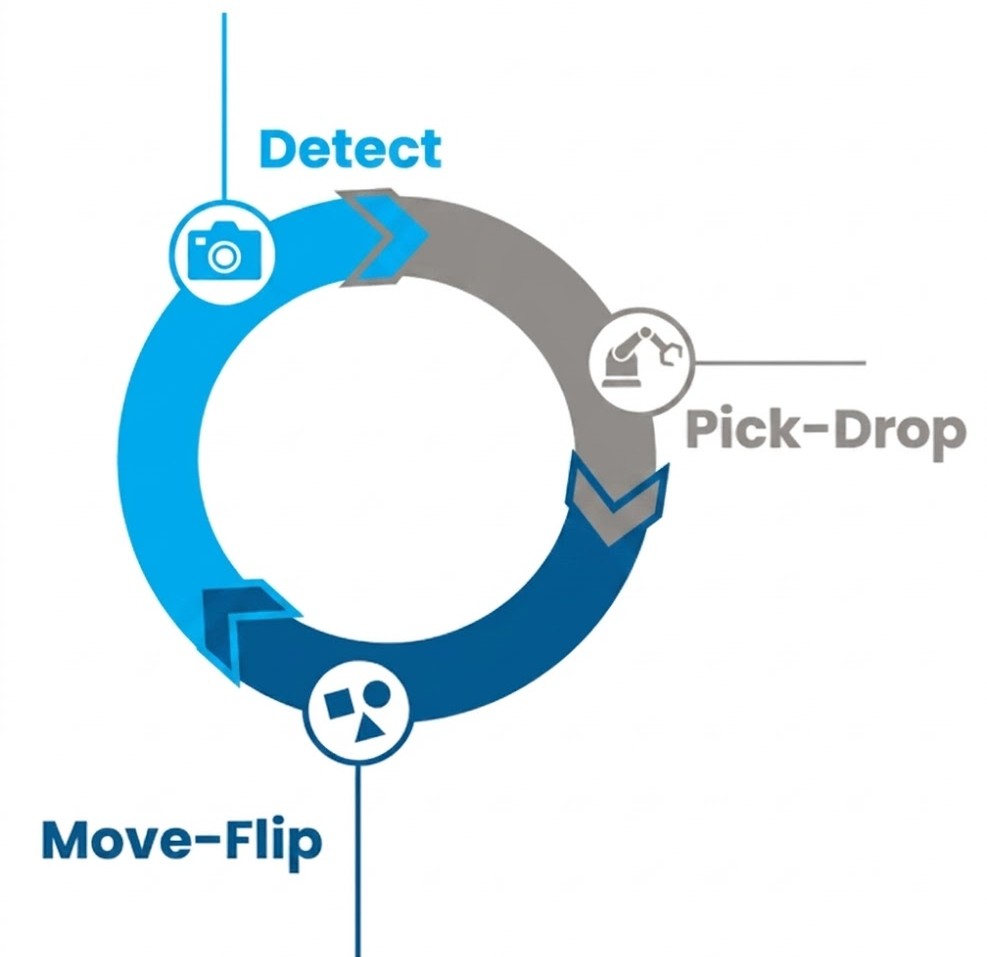
In Standard Mode, the FlexiBowl® runs a continuous cycle made up of three main phases, repeating in sequence:
1. Detect#
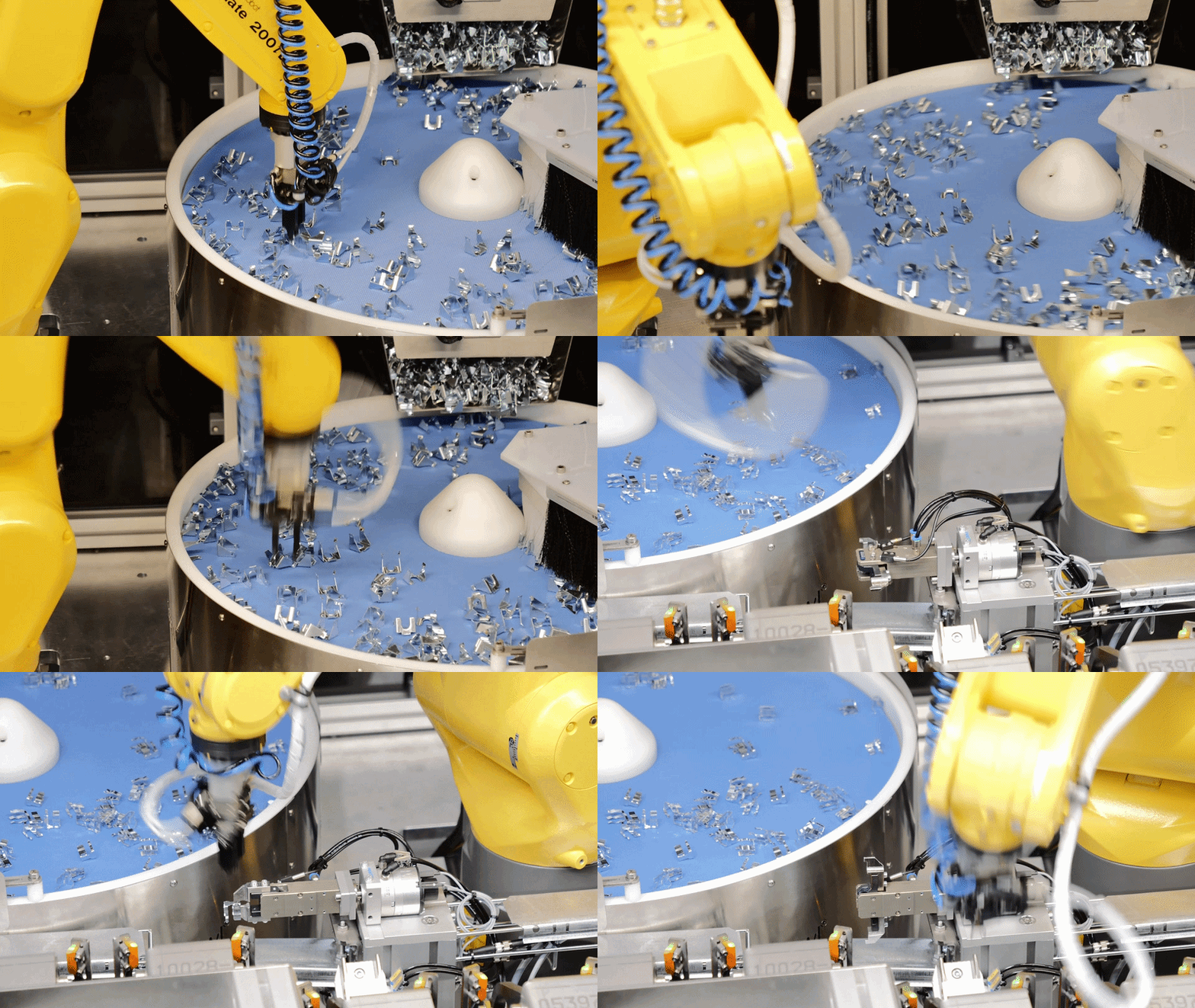
The vision system acquires an image of the FlexiBowl® surface and identifies the position, orientation and type of the components present. The information is sent to the robot to plan the picking operations.
2. Pick-Drop (Picking and Placing)#
The robot picks the correctly oriented components from the FlexiBowl® and places them in the destination position (e.g. tray, conveyor belt, assembly station). The vision and picking activities are performed sequentially: first the vision system scans the scene, then the robot intervenes.
3. Move-Flip (Movement and Flipping)#
At the end of the picking, the FlexiBowl® performs a combined rotation and vibration movement (flip) to reshuffle the remaining components and promote the correct presentation of new parts. At the same time, the hopper discharge and the bowl movement are performed simultaneously, optimizing the cycle times.
Main features#
Feature |
Description |
|---|---|
Shared work area |
The robot and the vision system operate in the same area of the FlexiBowl® |
Applicability |
Suitable for all types of application |
Hopper discharge |
Performed simultaneously with the movement/pulse of the FlexiBowl® |
Vision and picking |
Performed in sequence |
Cycle measurement |
The cycle time is measured on a per-minute basis |
Operating cycle diagram#
The cycle runs according to the following closed-loop scheme:
Detect — The vision system scans the FlexiBowl® and locates the components.
Pick-Drop — The robot picks the identified parts and places them at the destination.
Move-Flip — The FlexiBowl® reshuffles the components for the next cycle.
The cycle starts again from point 1.
Note
During the Move-Flip phase, the hopper discharge takes place in parallel with the movement of the FlexiBowl®, reducing dead times and maximizing productivity.
Layout example#
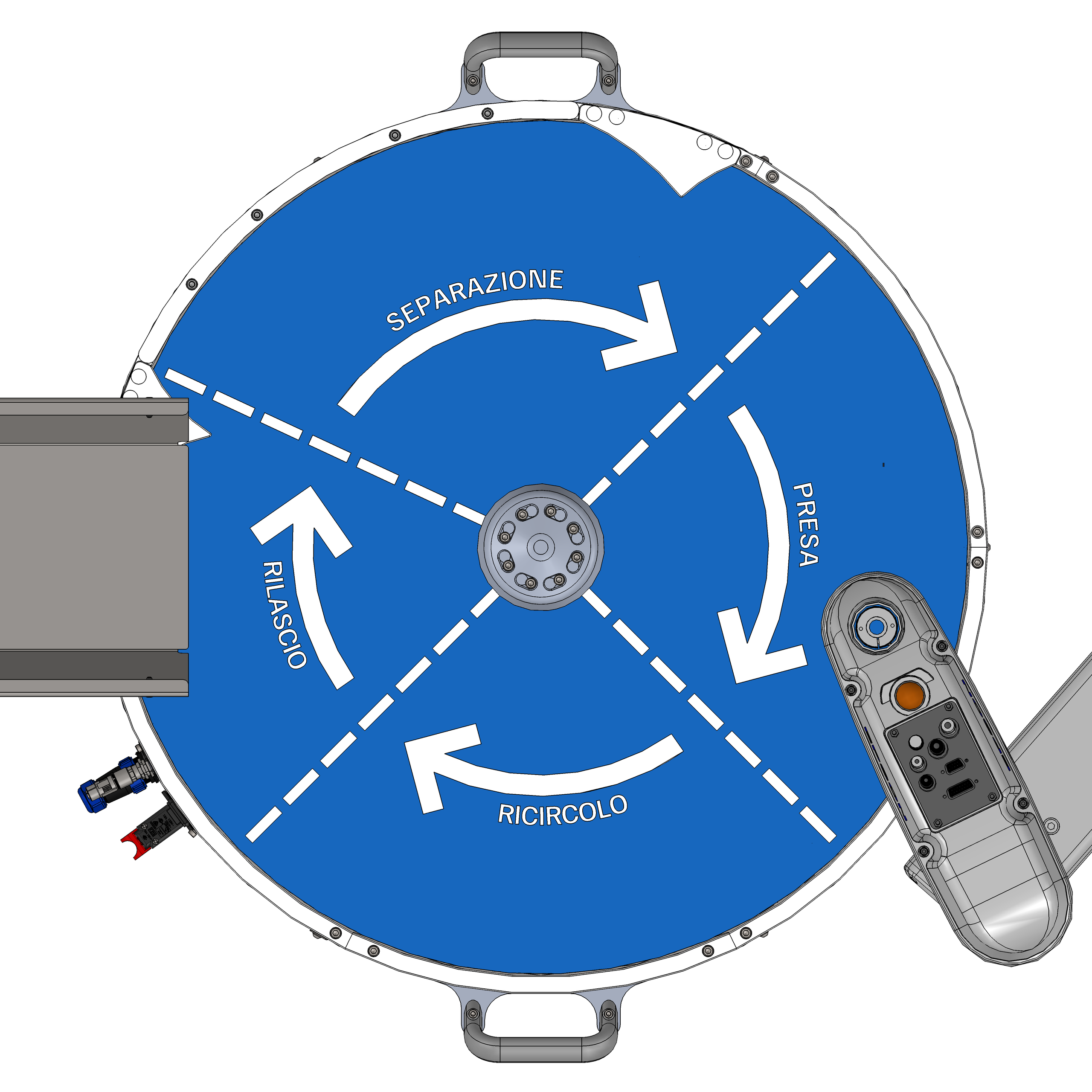
Layout example in Standard Mode: the Bulk Feeder discharges into the release sector, the flip separates the components, the robot picks in the vision area and the parts not picked recirculate.#
The robot work area must fully cover the vision area, so that the robot can reach all the components recognized as pickable. For the positioning of the robot, Bulk Feeder, deposit points, camera and lighting, refer to Layout Best Practice.
Advantages#
Accuracy: vision and picking are performed in sequence, so the detected position matches the actual one at the moment of the pick and no motion compensation is needed.
Separation: The flip shuffles the components and spreads them over the surface, while the Bulk Feeder discharges them into the release sector. Parts are therefore well separated in the vision area, and those not picked recirculate.
Speed: The release of the components takes place in parallel with the FlexiBowl® movement, reducing dead time in the cycle and keeping productivity high.