

General Preliminary Information#
Important
Before installing, using or carrying out maintenance on the machine, carefully read the entire manual and all the attached documentation.
Failure to follow the instructions given may cause:
damage to the machine;
loss of safety conditions;
risks to operators and maintenance personnel;
loss of the warranty.
Identification#
Identification Plate#
The machine is fitted with an identification plate located on the vibrating base. The details shown on the plate must be quoted in every communication with ARS S.r.l.
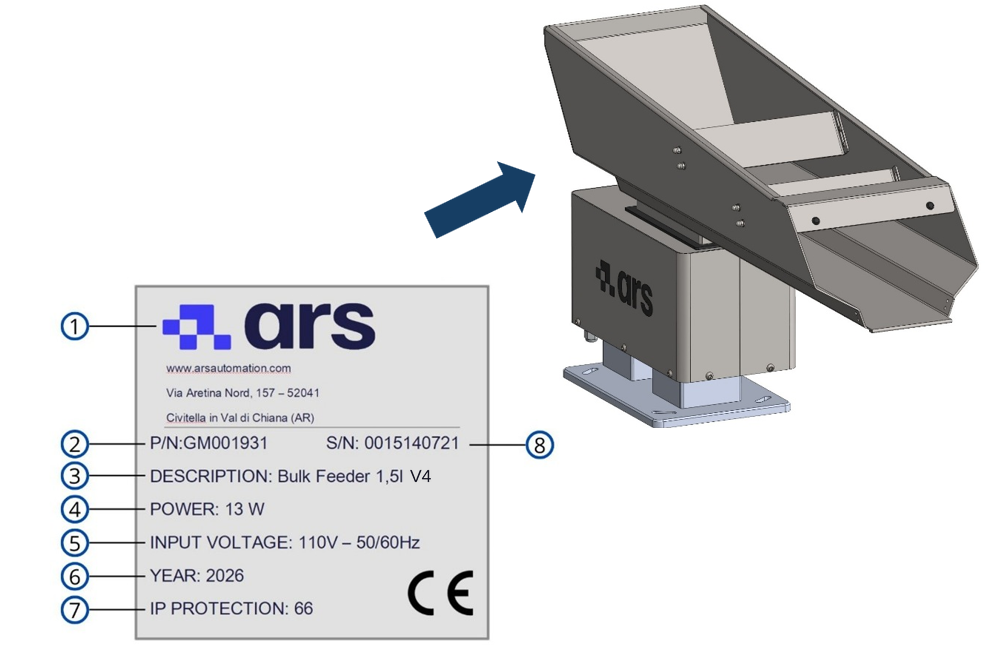
| Pos. | Item on the plate |
|---|---|
| 1 | Manufacturer logo |
| 2 | Part no. |
| 3 | Machine model |
| 4 | Power |
| 5 | Supply voltage |
| 6 | Year of manufacture |
| 7 | IP protection rating |
| 8 | Serial no. |
Warning
WARNING — CE identification plate
It is absolutely forbidden to:
remove the CE identification plate;
replace it with unauthorised plates.
If the plate is damaged or removed by accident, the customer is obliged to inform the Manufacturer immediately.
EC Declaration of Conformity (Copy)#
We: ARS S.r.l. – Via Aretina Nord, 157 – 52041 Pieve al Toppo (AR), Italia
Declare under our exclusive responsibility that the product:
BULK FEEDER 1,5 lt / 3 lt / 5 lt / 10 lt / 20 lt / 40 lt
is compliant with the following standards and regulations:
- DLGS 17/2010
- 2006/42/EC – "Partly completed machinery"
The machinery described above is intended to be incorporated into other machinery and must not be put into service until the relevant machinery into which it is to be incorporated has been declared in conformity with the essential health and safety requirements of Directive 2006/42/EC.
Reference Directives#
The machine supplied by ARS S.r.l. does not fall within the categories listed in Annex IV of the Machinery Directive; the conformity assessment procedure with internal checks on manufacture (Annex VIII) therefore applies.
The technical construction file is drawn up in accordance with Annex VII of Directive 2006/42/EC and is available to the supervisory authorities on reasoned request.
The machine is placed on the market accompanied by:
CE marking
EC Declaration of Conformity
Instruction manual and warnings (point 1.7.4 of Machinery Directive 2006/42/EC)
| Directive | Description / Scope |
|---|---|
| 2006/42/EC | Machinery Directive |
| 2014/30/EU | Electromagnetic Compatibility Directive |
Recipients, Supply and Storage#
The manual is intended for the operators in charge of using and managing the machine in all phases of its technical life. The manual, together with the CE certificate, is an integral part of the machine and must accompany it on every move or resale.
Aspect |
Requirement |
|---|---|
Integrity |
Keep intact. If lost, request a copy immediately from the Manufacturer. |
Changes of ownership |
Must follow the machine until demolition (moves, sale, hire, lease). |
Format |
Supplied in electronic format, with attachments (electrical diagrams, sub-supplier manuals). |
Attachments |
The attached manuals form an integral part; the same requirements apply. |
Original language |
Italian. In the event of discrepancies with the translations, the original text prevails. |
Updates |
Handled by the Manufacturer. The user ensures that only updated versions are in use. |
Attention
The Manufacturing Company declines all liability for improper use of the machine and/or for damage caused by operations not covered in the technical documentation.
Operator Profiles and Qualifications#
All the above qualifications must fall within the category of “Trained Person”:
Safety Symbols#


Technical Glossary#
| Term | Technical Definition |
|---|---|
| Lifting accessories | Components not connected to the machines that allow the load to be gripped, placed between the machine and the load (including slings and their components). |
| Breakdown | Fault that prevents the normal operation of a machine or plant. |
| Chains, ropes or belts | Elements designed for lifting as an integral part of machines or lifting accessories. |
| Damage | Any negative consequence arising from the occurrence of a hazardous event. |
| PPE | Personal Protective Equipment: products designed to safeguard the health and safety of the workers who wear them. |
| Machine | Assembly equipped with a drive system, consisting of parts (at least one of which is movable), connected for a specific application. |
| Malfunction | Faulty or inadequate operation of a machine or of one of its elements. |
| Hazard | Potential source of harm which, if not avoided, entails a risk to safety and health. |
| Protection | Defence against whatever can cause harm. It can be Active (operated by the operator) or Passive (acts without human command). |
| Guard | Physical barrier, designed as a structural part of the machine, to provide protection. |
| Risk | Combination of the probability and the severity of an injury or damage to health in a hazardous situation. |
| Residual risk | Risk that remains after the protective and preventive measures adopted at the design stage. |
| Intended use | Use of the machine in accordance with the information provided in the instructions for use. |
| Foreseeable misuse | Use not intended by the designer, resulting from readily predictable human behaviour. |
Mandatory Personal Protective Equipment (PPE)#
When close to the machine (assembly, maintenance, adjustment) the following PPE must be used:







Warning
SAFETY CLOTHING
The clothing of the personnel must comply with the essential requirements of EU Regulation 2016/425 and with the laws in force in the country of installation. Failure to comply may compromise the safety of the operator and of exposed persons.
Mapping of Safety Areas#
Warning
ACCESS TO HAZARDOUS AREAS
The risks in the machine areas are protected by physical guards (casings, doors) and interlocked electrical devices (sensors, microswitches).
When the system is active it is strictly forbidden to:
climb over the guards;
bypass the safety devices;
work inside the protected areas.
Removing or circumventing the safety systems can cause serious injury to persons and damage to the machine.
Warranty Conditions and Limits#
The full clauses are set out in the sales contract, whose conditions always take precedence over this manual.
- Packaging opened with suitable means without damage to the systems.
- Installation and start-up carried out in the presence of qualified technicians.
- Use within the nominal limits declared in the contract.
- Maintenance within the set times with original ARS S.r.l. spare parts entrusted to qualified personnel.
- Failure to comply with the safety rules or instructions.
- Installation or use in unsuitable environments.
- Removal or tampering with control and safety devices.
- Removal or alteration of the CE plate or pictograms.
- Unauthorised changes to the software (PLC, logic, passwords).
- Improper use or entrusting to unauthorised personnel.
- Mechanical/electrical/pneumatic modifications without written authorisation from the Manufacturer.
- Anomalies in the supply of power.
- Failure to carry out the scheduled maintenance plan.
- Final disposal in breach of the environmental regulations in force.
Safety features#
Measurements carried out in accordance with UNI EN 11200 and UNI EN ISO 3746. Noise exposure during operation is equal to 90 dB. The actual level on site may vary depending on the type of installation, the adjacent machines and the characteristics of the environment.
The vibrations produced by the machine under normal operating conditions are not hazardous to the health of the operators. Excessive vibration is a symptom of mechanical failure and must be reported and eliminated immediately.
The machine complies with the EMC Directive. The emission values fall within the regulatory limits thanks to the use of certified components, suitable connections and filters where necessary. Non-compliant maintenance work or incorrect replacement of components may compromise this compliance.
Attention
OBLIGATION — Personal protective equipment must be used during operation of the machine.
Residual Risks#
The machine has been designed to ensure the essential safety requirements; however, residual risks remain in the phases of:
transport and installation
normal operation
adjustment and setting up
maintenance and cleaning
dismantling and decommissioning
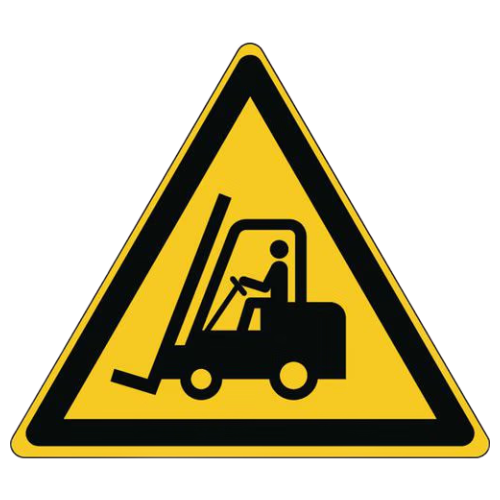
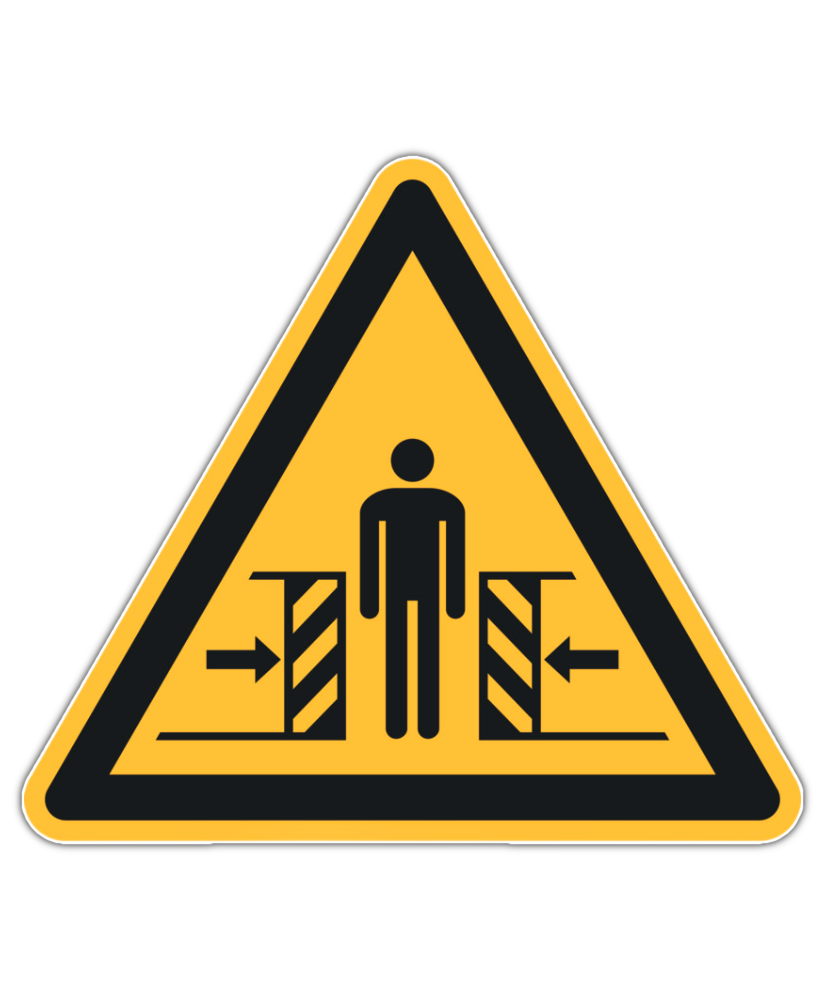
The detailed procedures are described in the chapter "Transport and installation".
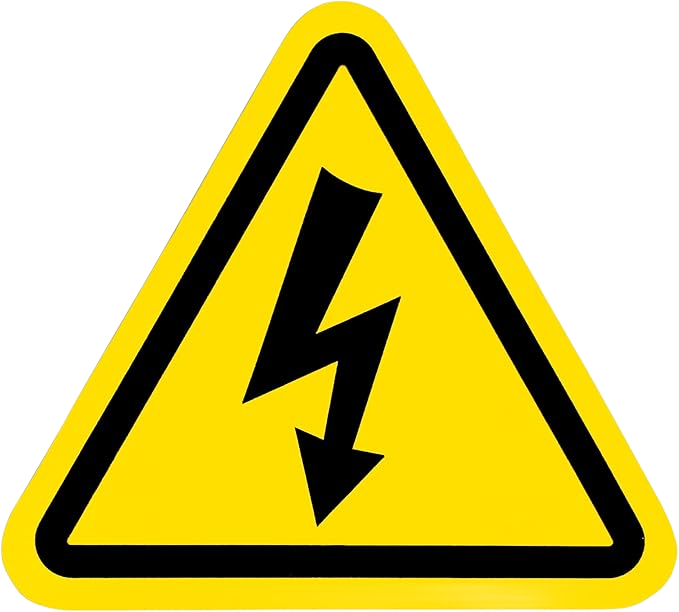
- Observe the safety pictograms relating to electrical risk.
- Do not carry out maintenance without first isolating the power supply.
- Consult the manuals of the commercial equipment for specific recommendations.
- Periodically inspect the equipotential bonding circuit.
Attention
Do not carry out maintenance and cleaning activities without first de-energising all the energy sources present.
Attention
It is absolutely forbidden to remove the safety guards or open the fixed guards without first isolating the electrical and pneumatic power supply of the machine.
The user is required to:
analyse the handling and installation risks within their own premises;
raise awareness among and train the personnel assigned to the operations;
apply visual safety signs in the working environment.